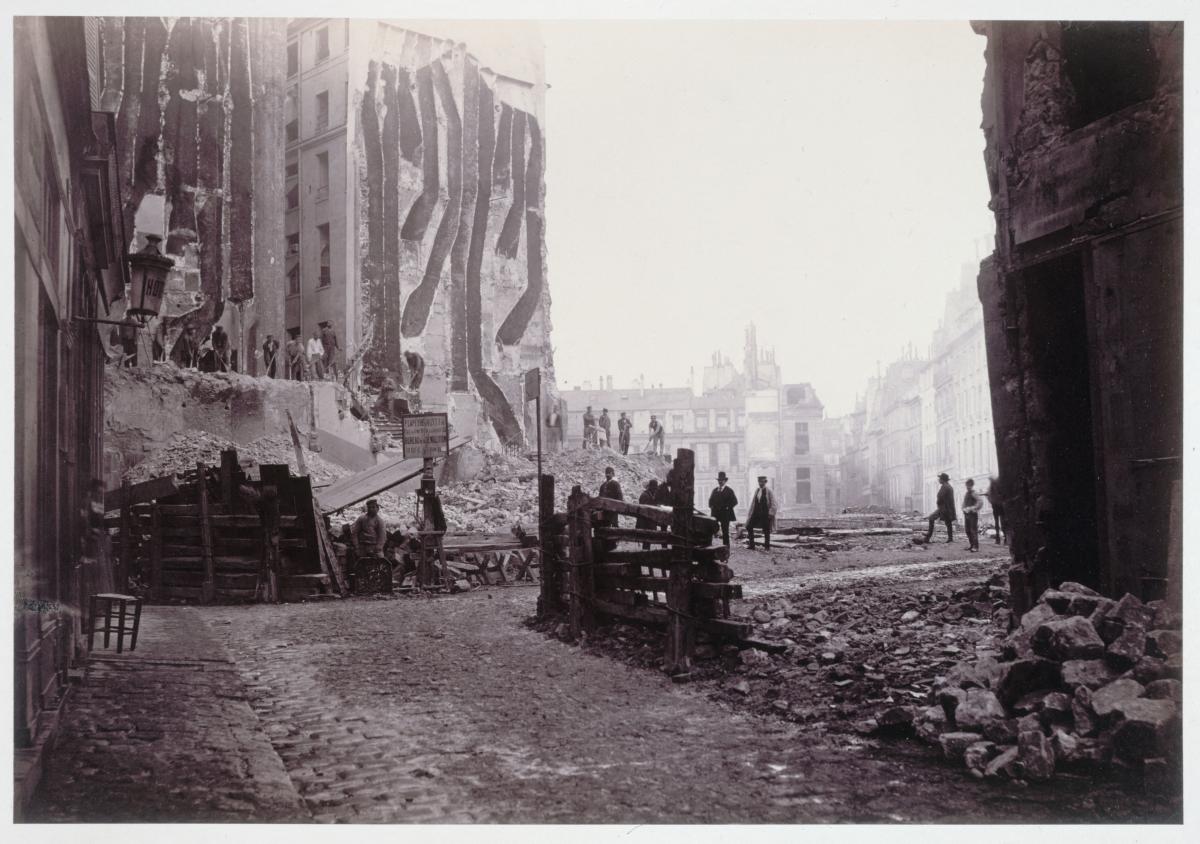
Percement de l'avenue de l'Opéra : chantier de la rue d'Argenteuil près de la rue Saint-Honoré, 1er arrondissement, Paris
Marville, Charles (Charles-François Bossu, dit), né en 1813, décédé en 1879, Marville, Charles (Charles-François Bossu, dit), né en 1813, décédé en 1879
Normal 0 21 false false false FR X-NONE X-NONE /* Style Definitions */ table.MsoNormalTable {mso-style-name:"Tableau Normal"; mso-tstyle-rowband-size:0; mso-tstyle-colband-size:0; mso-style-noshow:yes; mso-style-priority:99; mso-style-parent:""; mso-padding-alt:0cm 5.4pt 0cm 5.4pt; mso-para-margin:0cm; mso-para-margin-bottom:.0001pt; mso-pagination:widow-orphan; font-size:10.0pt; font-family:"Calibri","sans-serif"; mso-bidi-font-family:"Times New Roman";}
Work on the creation of Avenue de l’Opéra, which would tie the Louvre to the Palais Garnier, had fallen behind. With the approach of the International Exhibition of 1878, work was restarted at a stepped-up pace in June 1876, since Paris wanted to look its best for the exhibition. To keep a record of this operation, the city’s Planning Department called on Charles Marville, who made seven shots of the worksite. Five of these were reproduced as engravings for the issue of L’Illustration dated February 24, 1877. The photos showed the leveling of the former Butte des Moulins.
During the International Exhibition, Marville showed the work he had done for the city—from pictures of the old streets to images of the new ones, by way of urban furnishings (lampposts, urinals, Morris columns)—for which he received a silver medal. The Carnavalet Museum conserves over a thousand of the photographer’s shots, which cover his entire career.